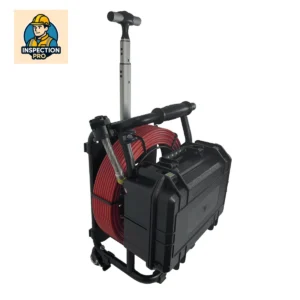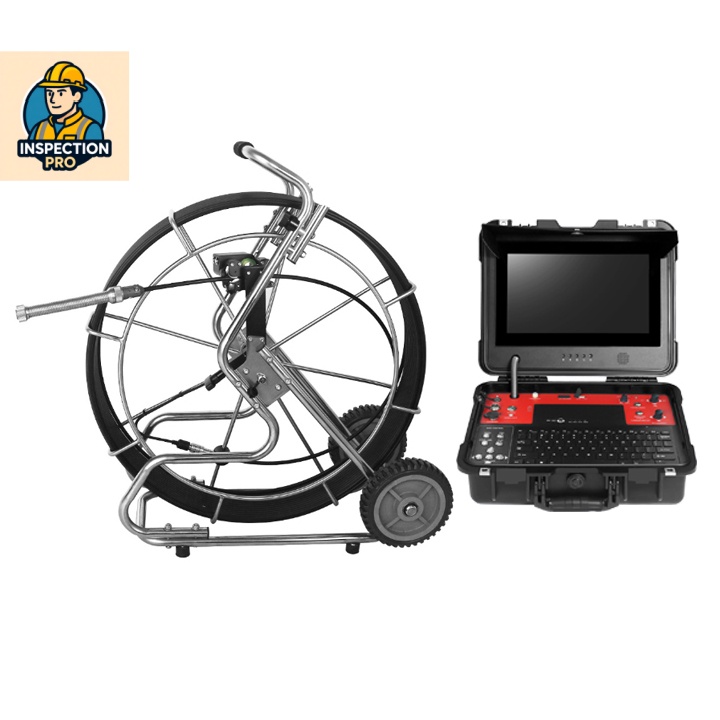
Sewer Inspection Camera with Rotating Camera

A standard push camera only looks straight ahead. When you hit a lateral connection, a crack on the side wall, or a joint that looks wrong from one angle but fine from another — you’re guessing. This sewer inspection camera with rotating camera head fixes that.

The 50mm pan tilt head rotates a full 360 degrees and tilts 180 degrees. You find something suspicious, you turn the camera and look at it properly — from the front, the side, straight up at the crown of the pipe. No pulling the cable back out, no second pass, no guessing. For sewage camera inspection work on commercial mains, municipal laterals, or any pipe where a straight-ahead view isn’t enough, this is the system that gives you the full picture.

60m or 100m fiberglass push rod cable. 13-inch IPS monitor with DVR recording. 8800mAh built-in battery. 512Hz sonde available as an add-on. Ships ready to work.

360° Pan, 180° Tilt – See Every Inch of the Pipe, Not Just What’s Straight Ahead

Most sewer cameras show you what’s directly in front of the lens. That’s fine for a blocked drain. It’s not fine when you need to assess the full condition of a commercial main or check a lateral connection properly. The 50mm pan tilt head on this sewer inspection camera with rotating camera head turns a full 360 degrees and tilts 180 degrees — you control the view from the surface with the joystick on the controller. Spot something on the pipe wall, turn the camera, look at it straight on. No assumptions, no second visits.


50mm Head – Built for the Larger Pipes That Need a Proper Look

The 50mm pan tilt head is designed for larger diameter pipes — commercial mains, municipal sewers, stormwater infrastructure. Pipes where a smaller head gives you a narrow, distorted view that misses what’s actually happening on the pipe walls. For sewage camera inspection work on pipes from 6 inches up, the 50mm head gives you the coverage that a standard push camera simply can’t.


Manual Focus – Sharp Images at Any Distance

One-touch manual focus lets you adjust sharpness on the spot. Whether you’re looking at a joint three centimeters away or assessing the crown of a pipe further down the line, you control the focus rather than relying on autofocus that gets confused in low-contrast pipe environments. For formal inspection documentation where image clarity matters, that control is worth having.


IP68 Waterproof – Goes Into the Pipes Nobody Wants to Think About

The camera head is IP68 rated — fully sealed against continuous submersion. Sapphire glass lens window, stainless steel body. It goes into standing water, grease, sediment, and the kind of sewage camera inspection conditions that destroy lesser equipment, and it comes back working. That’s what IP68 actually means in a drain environment.


13-inch IPS Monitor – Big Enough to See What You’re Actually Looking At

When you’re doing a detailed sewage camera inspection on a commercial pipe and you need to identify whether that’s a crack, a joint offset, or just surface deposits — screen size matters. The 13-inch IPS display gives you the real estate to see fine detail clearly. Waterproof keys and panel, 1280×720 resolution, battery level indicator, nine language options. Everything you need for a full day of inspection work on one screen.


USB Wireless Keyboard – Type Notes Without Putting Down the Controller

The wireless keyboard lets you add text directly to the footage in real time — pipe reference numbers, condition notes, location markers, client details. You’re typing while you inspect, not writing things down on a notepad and trying to match them up with footage timestamps later. For inspection companies producing formal reports, that’s a real time saver.


Digital Meter Counter – Know Exactly Where You Are in the Pipe

The on-screen digital meter counter tracks cable distance with less than 1% error. When you find a crack at 47 meters, you know it’s at 47 meters — not somewhere around there. That precision is what turns inspection footage into a useful condition report that actually tells a client or an engineer something specific.


8800mAh Built-In Battery – A Full Day Without Hunting for a Power Source

The 8800mAh lithium battery runs the whole system — camera, monitor, DVR — for a full working day without needing to find a power outlet on site. Battery level shows on screen so you know where you stand before you commit to pushing another 60 meters of cable. For inspection crews working on remote sites or locations without easy power access, that matters.


60m or 100m Cable – Match the Cable to the Job

Choose 60m for most commercial sewer camera inspection work. Go 100m for the longer municipal runs and extended infrastructure surveys where a shorter cable simply doesn’t reach. The 7mm fiberglass push rod cable pushes cleanly through bends without buckling — stiff enough to maintain control at distance, flexible enough to navigate real-world pipe geometry.


512Hz Sonde Available – Add Locating When the Job Calls for It

The 512Hz sonde transmitter is an optional add-on. When you need to pinpoint a problem underground before anyone starts excavating, add the sonde and any standard 512Hz locator above ground picks up the signal and tells you exactly where to dig. If most of your work doesn’t require above-ground locating, the base system keeps the cost down.


DVR Recording with Audio – Complete Documentation Before You Leave the Site

Video, audio, and still photos all record through the DVR directly to USB drive. The built-in microphone captures verbal notes alongside the footage — so your inspection record includes what you said, what you saw, and exactly where in the pipe you were when you saw it. Hand the client documentation before you’ve packed the system up.


Modular, Field-Repairable – Spare Parts Available for Everything

Camera head, push cable, flex spring — all replaceable with basic hand tools. No sending the whole system back for a single damaged component. For inspection companies and distributors, a modular system means downtime is measured in hours, not weeks.
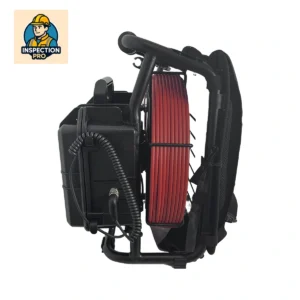
Pan Tilt Camera Head

Spec Details
Camera Head Size 50mm
Camera Body Dimensions Ø50mm × 154mm
Image Sensor 1/3″ CMOS, 2.0MP
Waterproof Rating IP68
View Angle 120°
Focus Manual focus, one-touch adjustment
Pan Range 360° continuous rotation
Tilt Range 180°
LED Lighting 4× high-brightness LEDs, adjustable
Front Lens Sapphire glass
Shell Material Stainless steel
Connector Detachable pin-type connection to cable reel
Sonde Transmitter 512Hz (optional add-on)

Push Rod Cable

Spec Details
Available Lengths 60m – 100m
Cable Diameter 7mm
Cable Construction Fiberglass push rod
Reel Dimensions 51 × 25 × 64cm
Distance Counter Digital, on-screen display, <1% error

DVR Control Unit / Monitor

Spec Details
Screen Size 13-inch IPS LCD
Display Resolution 1280×720
Waterproofing Waterproof keys and panel
Recording Video, audio, and photo DVR
Storage USB drive (included)
Keyboard USB wireless keyboard
Meter Counter Digital, displayed on screen
Battery 8800mAh rechargeable Li-ion
Battery Indicator On-screen battery level display
Languages English, Chinese, French, Spanish, German, Polish, Korean, Russian, Italian

What’s Included

Item Details
Camera Head 1× 50mm Pan Tilt head
Cable Reel 1× 60m or 100m fiberglass push rod
Monitor 1× 13-inch IPS LCD with built-in battery
Keyboard 1× USB wireless keyboard
Remote Control
Power Adapter
Plastic Guides Included
U Disk
Earphone
Testing Cable
Manuals User manual and guides

Q: What’s the difference between this pan tilt camera and a standard self-leveling sewer camera?

A standard self-leveling push camera looks straight ahead — the head stays upright automatically, but the lens direction doesn’t change. This sewer inspection camera with rotating camera head is different. The 50mm pan tilt head rotates 360 degrees and tilts 180 degrees, which means you can turn the camera to look at the pipe wall, check a lateral connection from the side, or look straight up at the crown of the pipe — all from the surface using the joystick on the controller. For sewage camera inspection work where you need to assess full pipe condition rather than just find a blockage, the pan tilt head gives you information a fixed lens simply can’t.


Q: What size pipes is the 50mm pan tilt head designed for?

The 50mm head is built for larger diameter pipes — generally 6 inches and above. For commercial mains, municipal sewers, and stormwater infrastructure in the DN150 to DN300 range and beyond, the 50mm head gives you the field of view and rotation capability to assess the full interior condition of the pipe. If most of your work is on smaller residential drain lines under 4 inches, a smaller head would be a better fit for that application.


Q: Is the 512Hz sonde transmitter included in the base system?

No — the 512Hz sonde is an optional add-on you can select at checkout. The sonde transmitter is built into the camera head when ordered with that option. To use it, you walk the surface above the pipe with any standard 512Hz locator and it picks up the signal, telling you exactly where the camera head is underground. If you already have a locator and only occasionally need locate capability on sewage camera inspection jobs, ordering it as an add-on keeps the base cost down for work that doesn’t require it.


Q: How do I control the pan and tilt rotation during an inspection?

The pan and tilt movement is controlled by a joystick on the DVR control unit — you rotate and tilt the camera head from the surface without touching the cable. While you’re pushing the cable and watching the 13-inch monitor, you use the joystick to turn the camera head in any direction. It takes about ten minutes to get comfortable with the controls on the first use. Most operators find it straightforward once they’ve run a short test inspection.


Q: Can I record footage suitable for formal condition reports and client documentation?

Yes. The DVR system records full video, audio, and still photos directly to the USB drive. The on-screen display stamps date, time, and cable distance onto the footage throughout the inspection. The wireless keyboard lets you type pipe reference numbers, condition notes, and location markers directly into the footage in real time. For sewage camera inspection work where clients need formal documentation — insurance claims, pre-purchase pipe assessments, municipal condition reports — the footage comes out ready to attach to a report before you’ve packed the system up.


Q: How long does the battery last on a full inspection day?

The built-in 8800mAh lithium battery runs the complete system — camera, monitor, pan tilt motor, DVR — for a full working day. Battery level shows on screen throughout the inspection so you always know where you stand. Unlike removable battery systems, this one is built into the control unit — so for very long multi-day inspection projects, access to a power source for overnight charging is something to plan for.


Q: What cable length should I choose — 60m or 100m?

If most of your sewer inspection camera work is on commercial properties, building drainage systems, or standard municipal laterals, 60m covers the majority of those jobs. Go with 100m if you’re regularly inspecting longer runs — extended municipal mains, large-scale stormwater infrastructure, or industrial pipelines where 60m doesn’t reach the full length of the pipe. It’s worth thinking about the longest job you do regularly rather than the average, because running out of cable halfway down a pipe is a problem that’s hard to fix on site.


Q: What happens if the camera head or cable gets damaged on a job?

Every component on this system is modular and field-repairable with basic hand tools — camera head, push cable, flex spring, connectors. All spare parts are available to order individually. If a camera head gets damaged, you replace the head, not the whole system. For inspection companies doing sewage camera inspection work daily, that’s the difference between a half-day repair and a week waiting for a full system replacement. We recommend keeping a spare flex spring and a spare camera head on hand if you’re running the system hard every day.