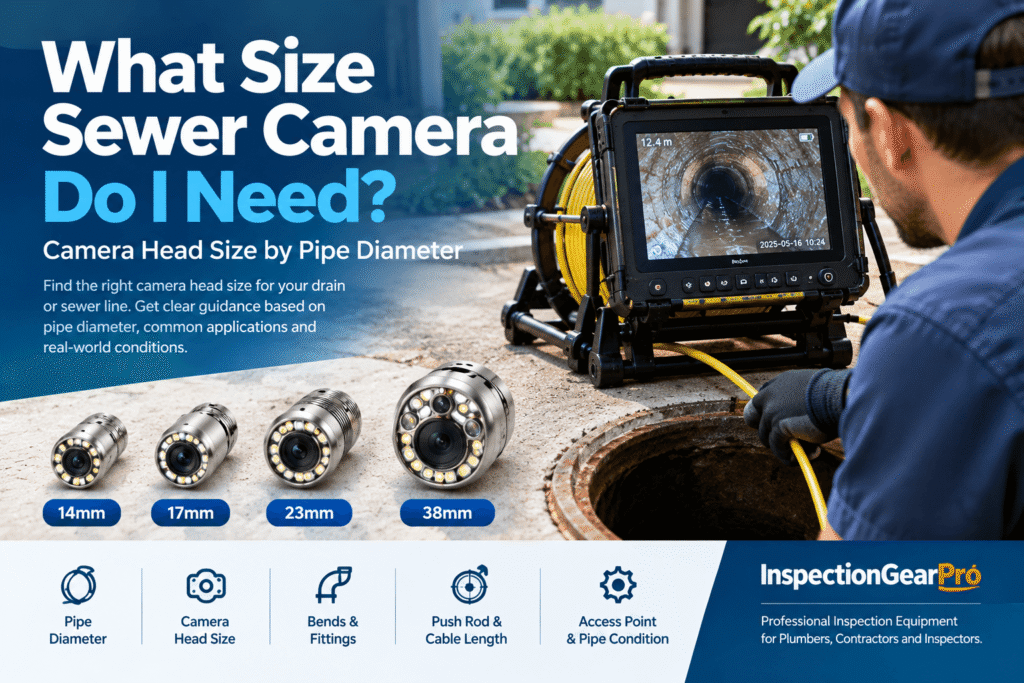
Choosing the right sewer camera size is mainly about camera head diameter, pipe diameter, and the tightest part of the line you need to inspect.
what size sewer camera do i need camera head size by pipe diameter
For many residential drain inspections, a 14mm or 23mm camera head is a practical starting point. A 38mm camera head is more suitable for larger pipe applications. However, pipe size alone does not determine whether a camera will pass through the line.
The access point, fittings, bends, pipe condition, push rod, and camera head design can all affect the result.
What Size Sewer Camera Do I Need?
There is no single camera size that works for every sewer or drain pipe.
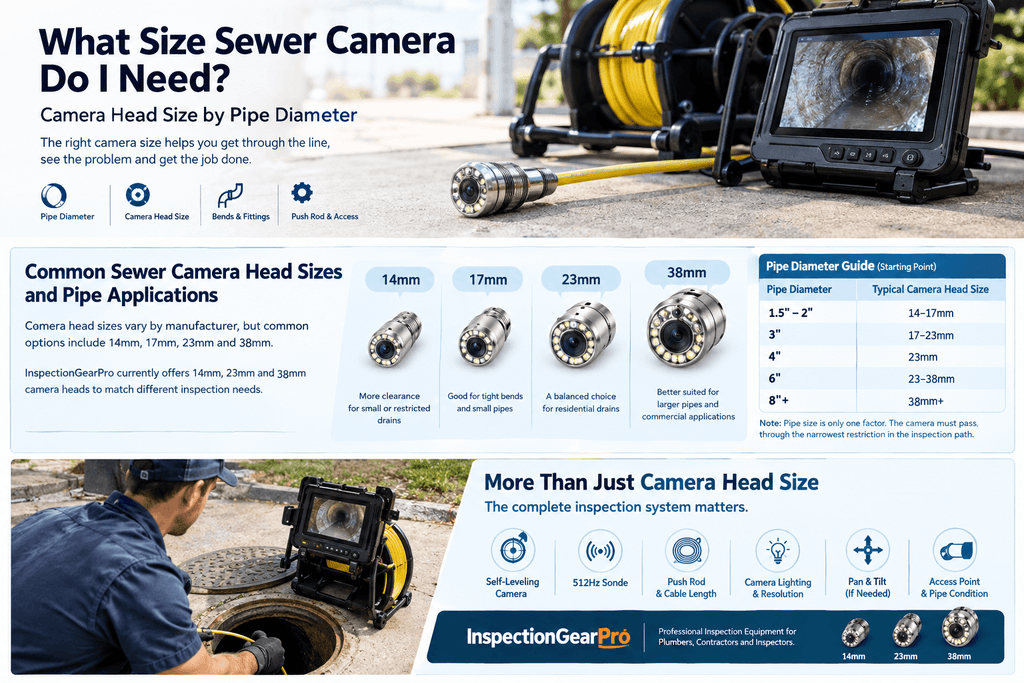
As a general starting point:
Pipe diameter
Typical camera head starting point
1.5–2 inches
14–17mm
3 inches
17–23mm
4 inches
Around 23mm
6 inches
23–38mm
8 inches and larger
Around 38mm or larger
These are starting points rather than universal rules. The camera needs to pass through the narrowest restriction in the inspection path, not simply fit inside the nominal pipe diameter.
For example, a 4-inch drain may have enough internal space for a 38mm camera in a straight section, but a tighter fitting or bend may make a smaller 23mm camera more practical.
The basic relationship is:
Smaller pipe → smaller camera head → more clearance
Larger pipe → larger camera head → more room for the camera assembly
But smaller is not automatically better, and larger is not automatically better. The right choice depends on what the camera needs to navigate and what you need to see.
What Size Sewer Camera Do I Need for a 2-Inch Pipe?
For a 2-inch drain, a 14–17mm camera head is generally a safer starting point than a larger camera head.
A 23mm camera may fit through some straight 2-inch sections, but the available clearance becomes more important at 90-degree elbows, P-traps, reducers, fittings, or sections with deposits.
This is why the nominal pipe diameter can be misleading.
A 2-inch pipe is not simply an empty 2-inch tube. The actual inspection path may contain:
Elbows
P-traps
Couplings
Reducers
Mineral buildup
Grease
Roots
Deformed pipe sections
For restricted 2-inch lines, the smaller camera head generally gives the push rod more clearance to work with.
What Size Sewer Camera Do I Need for a 3-Inch Pipe?
For a 3-inch drain, 17–23mm is a useful starting range.
A 17mm camera gives you more clearance and can be useful where the line contains tighter fittings or restricted access.
A 23mm camera provides a larger camera assembly and can be a practical choice when the pipe has enough clearance.
The decision is therefore not simply:
3-inch pipe = 23mm camera.
Instead:
3-inch pipe + access conditions + bends + camera head + push rod = actualcamera choice.
This distinction is important for residential plumbing inspections because the pipe’s nominal diameter does not tell you the geometry of every fitting in the inspection path.
What Size Sewer Camera Do I Need for a 4-Inch Pipe?
For many 4-inch residential drain lines, a 23mm camera head is a practical middle ground.
It provides more clearance than a 38mm head while offering a larger camera assembly than a very small 14mm head.
A 38mm camera can also be used in larger 4-inch applications when the pipe configuration allows it, but the larger head has less clearance around fittings and bends.
23mm vs. 38mm in a 4-inch pipe
23mm camera:
More clearance
Easier to accommodate in tighter sections
Suitable for many residential drain inspections
38mm camera:
Larger camera head
Better suited to larger pipe applications
Requires more available clearance
So if the inspection route contains several tight fittings, head diameter becomes more important than simply looking at the 4-inch pipe label.
What Size Sewer Camera Do I Need for a 6-Inch Pipe?
A 23–38mm camera head can be considered for many 6-inch applications, depending on the inspection equipment and pipe configuration.
At this size, the question changes slightly.
You are no longer only asking:
“Will the camera fit?”
You may also be asking:
“Will the camera provide enough visibility and control inside the larger pipe?”
A very small camera can physically enter a larger pipe, but that does not automatically make it the most useful setup for the inspection.
The camera head, lighting, self-leveling system, push rod, and pipe diameter all influence the inspection result.
What Size Sewer Camera Do I Need for an 8-Inch Pipe?
For 8-inch and larger pipes, a 38mm or larger inspection camera may be more appropriate, depending on the application.
Large-diameter pipe inspections can require equipment designed specifically for larger lines, including larger camera heads, stronger push systems, or specialized inspection platforms.
A small residential drain camera may still enter the pipe, but the question becomes whether it can provide adequate lighting, image coverage, cable control, and inspection distance.
For larger commercial or municipal lines, the correct equipment may therefore be very different from the camera used for a residential kitchen or bathroom drain.
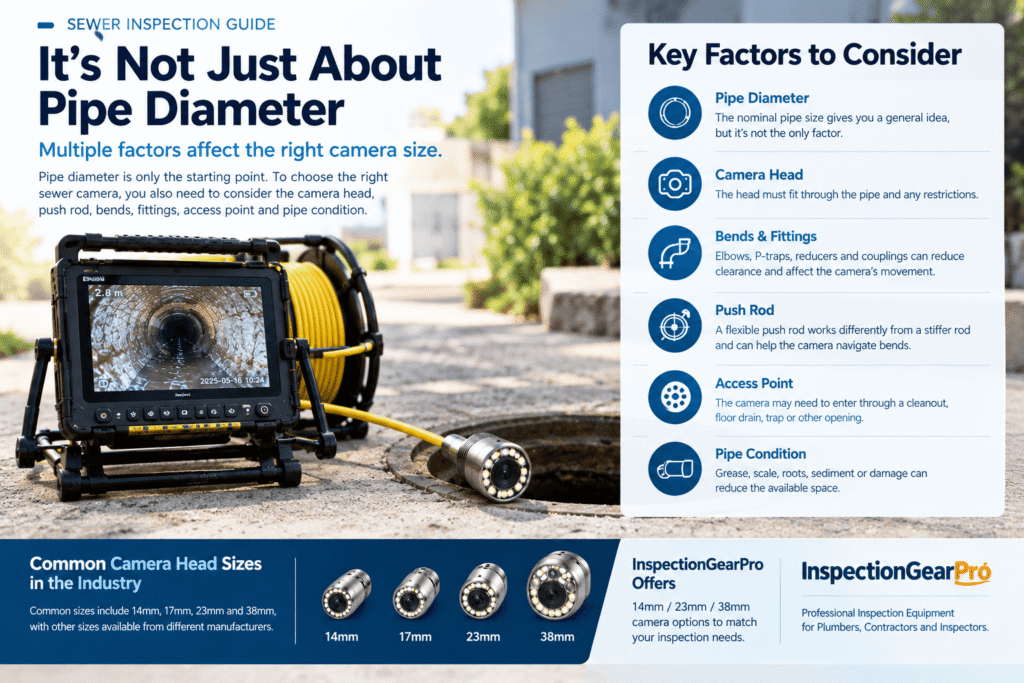
Does Pipe Diameter Tell Me What Sewer Camera to Buy?
No. Pipe diameter is only the starting point.
The complete inspection system matters.
Camera head diameter
The head must physically fit through the pipe and its restrictions.
Push rod
A flexible push rod can behave differently from a stiffer rod when navigating bends and fittings.
Bend geometry
Two 90-degree bends are not necessarily identical. The bend radius, fitting design, pipe diameter, and surrounding space can affect how the camera moves.
Access point
The camera may have to enter through a cleanout, floor drain, trap, or other access point before reaching the main line.
Pipe condition
Grease, scale, roots, sediment, collapsed sections, or other obstructions can reduce the available clearance.
This is why camera head diameter should be considered together with the entire inspection assembly, rather than as an isolated specification.
14mm vs. 23mm vs. 38mm Sewer Camera: What’s the Difference?
The simplest way to understand the three sizes is to think about clearance versus application size.
Camera head
Typical application
Main advantage
Main consideration
14mm
Small/restricted drains
More clearance
Less suited to larger pipes
23mm
Many residential drains
Balance of clearance and camera size
Needs more room than 14mm
38mm
Larger drain/pipe applications
Better suited to larger lines
Requires more clearance
14mm vs. 23mm
A 14mm head has a smaller physical diameter, so it generally provides more clearance in restricted pipe sections.
A 23mm head is larger but can provide a useful middle ground for residential drain inspection.
14mm is not simply “better” because it is smaller. If the pipe is large and the inspection requires more suitable camera hardware, a larger head may make more sense.
23mm vs. 38mm
The same principle applies.
A 23mm head provides more clearance, while a 38mm head is better suited to applications where the pipe provides enough room for the larger assembly.
The choice is therefore about application and clearance, not simply choosing the largest or smallest camera available.
Can a 23mm Sewer Camera Go Around a 90-Degree Bend?
It can, but there is no universal yes-or-no answer.
Whether a 23mm camera can navigate a 90-degree bend depends on:
Pipe diameter
Bend radius
Camera-head design
Push-rod flexibility
Access point
Pipe condition
Operator technique
For example, a 23mm camera may navigate one bend successfully but encounter difficulty at a tighter fitting or transition elsewhere in the same inspection.
This is also why a manufacturer’s claim about camera diameter should not be interpreted as a guarantee that the camera will pass every bend of a particular angle.
Camera diameter is one part of bend performance—not the entire story.
can a 23mm sewer camera go around a 90 degree bend
What Other Sewer Camera Features Should I Consider?
Camera head diameter is important, but it is not the only specification worth checking.
Self-leveling
A self-leveling camera keeps the image oriented as the camera moves through the pipe. This can make the inspection footage easier to interpret.
512Hz sonde
A 512Hz sonde allows a compatible locator to detect the camera’s position underground. This is useful when you need to identify where a defect or blockage is located from the surface.
Cable length
Cable length determines how far the camera can potentially travel, but longer is not automatically better. A longer push cable can also mean more weight and more cable to manage.
Camera resolution and lighting
A larger pipe does not automatically mean you need a larger camera head. The camera’s image quality and lighting also affect how useful the inspection footage is.
Pan-and-tilt capability
A pan-and-tilt camera can provide more control over the viewing direction than a fixed camera, which can be useful for larger or more complex inspection applications.
Which Sewer Camera Head Size Is Right for My Job?
The easiest way to approach the decision is:
Start with the smallest pipe or restriction you need to pass.
Then consider:
Pipe diameter → access point → fittings → bends → camera head → push rod → inspection distance → required visibility
For example:
Small/restricted drain: consider a 14mm-class camera
Typical residential drain: consider a 23mm-class camera
Larger 4–8 inch applications: consider a 38mm-class camera
Large commercial lines: consider equipment specifically designed for larger pipe inspection
InspectionGearPro offers sewer inspection systems using 14mm, 23mm, 38mm, and 50mm camera heads, depending on the application. The important point is not to select a camera based on head diameter alone, but to match the complete inspection system to the pipe and access conditions.
Quick Answer
If you’re searching for a simple rule:
Choose the camera head based on the smallest restriction you need to navigate, not just the nominal pipe diameter.
A 14mm head gives more clearance for smaller or restricted drains. A 23mm head is a practical middle option for many residential drain inspections. A 38mm head is better suited to larger pipe applications where there is sufficient clearance.
And if a job involves tight bends, P-traps, reducers, heavy deposits, or unusual access, pipe diameter alone isn’t enough to choose the camera.
FAQ
What size sewer camera do plumbers use? There is no single size used for every plumbing job. 14mm and 23mm heads are useful for many smaller residential drain applications, while larger heads such as 38mm are more appropriate for larger pipes.
What size camera do I need for a 4-inch sewer line? A 23mm camera is a practical starting point for many 4-inch residential drain inspections. The correct choice still depends on bends, fittings, access, and pipe condition.
Is a smaller sewer camera always better? No. A smaller camera provides more clearance, but a larger camera may be more appropriate for larger pipes and certain inspection requirements.
Does a 23mm camera fit a 2-inch pipe? It may enter some straight 2-inch sections, but tight fittings, bends, traps, and deposits can prevent it from traveling further. A smaller head provides more clearance.
What size sewer camera is best for 6-inch pipe? A 23–38mm camera can be considered depending on the pipe configuration and inspection requirements. For larger commercial lines, specialized equipment may be more appropriate.